23 February 2009

Crass

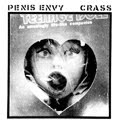
Penis Envy
Crass Records, 1981

Legend has it that the third album by Crass, Penis Envy, climbed to the top of the British independent charts despite not containing any singles. This is not entirely true. Teenage girls flicking through the May, 1981 "Bridal Special" issue of Loving magazine might have noticed a small coupon, nestled between stories like "Dreamy Wedding Dresses and Magical Make-Up" and "How Revealing Is Your Underwear?", advertising a free mail-order flexi disc. "Yes, folks, we've got together with Creative Recording and Sound Services* to offer you the chance to make your wedding day that extra bit special with this romantic song," the offer read. The song, titled 'Our Wedding', was so cheesy as to be absurd. Over pipe organ and church bells, a trembling female voice promised: "All I am I give to you/ You honour me, I'll obey you."

If anyone had looked for other records featuring the singer credited on the disc, Joy De Vivre, they would have stumbled upon on an album sleeve picturing a blow-up sex doll on one side and, on the other, a biblical quote about the creation of woman from man's rib laid over a photograph of pigs hanging in a slaughterhouse. And look for it they did. Especially after NME reported the hoax the following week, on the cover of its own facetious "Bridal Special". At the same time, a pamphlet was making its way around the English music scene – created by the band – which poetically (or melodramatically, depending on your point of view) explained feminist concepts such as the male gaze and accused Loving magazine of selling its readers fantasies of "pure unadulterated shit".

The album behind it all, Penis Envy, must have sounded like an industrial version of hell to listeners who weren't prepared. Far more confronting than the sound of most post-punk bands at the time and only mildly tempered by age, it is an acerbic and thrilling collection of what would probably be known nowadays as "electroclash" – punk vocals mixed with drum machine beats and primitive sound collages, funk bass and electric guitar made to sound like an emergency siren. On 'Health Surface' Joy De Vivre sang in the same satirical feminine voice as on 'Our Wedding', interrupted every now and then by giggles, about hospitals and death. For the rest of the album her counterpart Eve Libertine took over the microphone, spitting lyrics about gender constructions like razor blades: "Poor little filly/ They fuck her mind/ So they can fuck her silly."

* Note the acronym.

16 February 2009

Aleks And The Ramps

Aleks And The Ramps
Independent, 2005

Of the sexiest songs in pop music, few are as dark as The Birthday Party's 'She's Hit'. Built around a funereal bass line and a guitar more splintering hook than sinker, it conjures a film scene that doesn't exist – a couple, fitted in black and fishnet, slow-dancing to the jukebox in some ugly, orange-tiled suburban pub.

It seems trite to reference The Birthday Party nowadays, prominent as they are in the currently fashionable post-punk canon. But few could deny singer Nick Cave's twisted sexuality, for better or worse – from the crudely scratched illustrations of strangled women in the liner notes of Tender Prey to the housewife-melting 'Into My Arms'. The first track from Aleks And The Ramps' self-titled debut, a strange epic titled 'If You Want It Come And Get It', is propelled by the same hip-grinding, gothic funk rhythm as 'She's Hit', but louder and interspersed with... um, a banjo?

Yes, a banjo. And a piano, and a xylophone, and a viola, and some other things I'm not quite sure about at all. It's thoroughly disorientating upon first listen, combining experimentalism, story-telling and snippets of pop melody into an (in?)coherent whole. The lyrics are both sinister and erotic, as Aleks's voice seeps into the jumble: "At first you thought it was a coincidence/ Your bedroom window was in line with the hole in our fence/ And I could tell you were pretending not to know/ That late at night I could see you perform your little show..."

The four-track record captures the same sense of perpetual creation as the band's live show, but proves to be a much darker experience. Final track 'Graveyard Etiquette' is an innocent, off-kilter blend of electronica and folk that collapses on itself half-way through. From the subsequent mess of guitar and percussion blooms an ominous "doo-wop-bah" refrain, like a carnivalesque mushroom cloud. It ends, two minutes later, with an accidentally recorded cough.

Aleks And The Ramps isn't the most polished record of the last year, but it is one of the bravest and — by no coincidence — the most interesting. It's a pity we're only catching up with it now. Aleks, like his exhibitionist female lead, just happened to get lost along the way: "I saw your missing persons photo again/ The thought of you with devil horns made me wish I had a pen..."

Andrew Ramadge is on holidays. This review was first published in Mess+Noise.

9 February 2009

The Cramps

Live At Napa State Mental Hospital
Target Video, 1984

It's one of the more unusual gigs captured on film. The singer, Lux Interior, shakes his body and runs up and down the steps at the front of the stage trying to get the crowd to dance. The guitarist, Byron Gregory, sneers at them while chomping on a cigarette and pausing occasionally to blow a cloud of smoke in someone's face. Poison Ivy stands off to the side, looking at the neck of her guitar, her hair puffed up and knees bent, perched on high heels as if she was ready to pounce. The footage is blurry and black and white, taken on an old hand-held camcorder that pans clumsily around the room.

It takes a while for the crowd to warm up. Near the front, at the top of the steps, a shabby man in a suit and tie begins to jog on the spot as if he was exercising. He glances over his shoulder every now and then to see what everyone else is doing. Next to him a young man in a shirt and jeans starts to double over in time to the rockabilly beat, lurching back and forth with growing momentum until he looks as if he's about to hurl his body into the drum kit. Lux drags a guy in a cowboy hat up the stairs, but he scampers back into the crowd as soon as the singer lets go of his hand.

"We're The Cramps and we're from New York City," Lux announces to the recreation room of the Napa State Mental Hospital in California, "and we drove 3000 miles to play for you." A woman somewhere at the back cuts through the cheering. "FUCK YOU!" she screams in a nasal accent. "Somebody told me you people are crazy," Lux continues, "but I'm not so sure about that." The band fire up the next song and Lux, tall and thin and dressed in black, bent over with his greasy dark hair and his deranged wide-eyed smile, pushes his face right up to a young man in a leather jacket and sings: "The way I walk is just the way I walk/ The way I talk is just the way I talk/ The way I smile is just the way I smile/ Touch me baby and I'll go home wild!"

Lux Interior died last week of a heart condition aged 60.

2 February 2009

Broken Social Scene

You Forgot It In People
Arts & Crafts, 2002

It's no coincidence that the opening track on Broken Social Scene's second album, You Forgot It In People, sounds like an underwater scene – an instrumental with shimmering chimes, muffled echoes here and there and horns like far-off whale calls. It only lasts for a minute or two before the rock and roll kicks in, but that sense of fluidity never leaves. It is an album obsessed with the flow of liquids, from the barrage of images of mouths and lips and teeth and kissing, to ships sailing off into the horizon, menstrual blood and dick-sucking and finally, the wonderful piece de resistance, the climax of a song near the end of the album called, with such fantastic and brutal brevity, 'Lover's Spit'. "All these people drinking lover's spit/ Swallowing words while giving head," Kevin Drew croons over fuzzy guitar and piano keys, his voice lazy and gorgeous and effortless, seeping out of him like the tides in his lyrics. "He is a very fluid person," said guitarist Andrew Whiteman when I asked about the singer during an interview a few years ago. "As such, he is very fond of fluids – piss, vomit and cum being his favourite three."

Broken Social Scene were involved in two notable shifts this decade. They were first introduced to an audience outside Canada by Pitchfork Media critic Ryan Schreiber, who slogged through "boxes upon boxes" of promo discs looking for the next decent band to write about before stumbling onto their wonderful second album, and, in turn, ensuring that his online magazine would be touted as an influential tastemaker for the next ten years. The band, a collective of Toronto musicians from bands such as Stars, Feist, Apostle Of Hustle, Do Make Say Think and a dozen or so more, also made popular the idea of the indie ensemble – the super-group of musicians from a particular town or city who collaborate as a whole and as individuals, most notably represented since then by Animal Collective from Baltimore. It didn't hurt that Broken Social Scene were amazing on stage, either. When they played in Melbourne to promote their third, self-titled album, the musicians seemed to have more stamina than the audience. The crowd seemed to be enduring it by the end – more than two hours of relentless and pitch-perfect orchestra pop with lyrics about desire and bodily fluids.