20 April 2009

Genesis

Invisible Touch
Virgin, 1986

When I was a child, my father wanted me to grow up. One day I came home from school excited after learning about the inner workings of medieval castles and the role of the gongfermor, who had to empty the chamber that the toilets drained into. "Dad, what's the worst job in the world?" I asked, expecting the chance to tell him all about the poor shit-farmers. Instead, he replied: "Burying dead children in Bosnia." He was right, I suppose, but it wasn't exactly what I had in mind. That year for Christmas he bought me a copy of My Hiroshima, a picture book about a young girl who survives the nuclear bomb attack and returns home to sift through the bones of her friends. I had nightmares for months.

Around the same time, I began listening to a cassette of Invisible Touch by Genesis that I found in one of my parents' cupboards. When it was released five or six years earlier, it had spent weeks at the top of the charts and sold millions of copies – but I didn't know any of that. To me it was unusual and secret. I had never heard of the band before, or heard my parents play it on the stereo. I listened to it in my room, on my Walkman, and became fixated on a creepy song on Side B that had lyrics about some sort of futuristic nuclear war with children screaming and blood everywhere. I remember it seemed more like a story than a pop song, and I listened to it over and over even though it scared me.

Today I listened to that song, called 'Domino', for the first time in more than fifteen years. My memory was half-right. It is like a story – at ten minutes long and with more than a dozen verses. In fact, it's even broken into two parts, which were originally included on the flip-sides of the album's singles. Musically, it's not so much creepy as indulgent. It sounds like an '80s pop take on the sort of fantastical epic you'd find in prog-rock. The imagery is just as strong as I remember, though. In the opening verse there is rain running down a window. Four minutes in, the song turns nightmarish and the water is replaced with red. Then it turns into a "beautiful river of blood", where children swim and play before their bodies dissolve into the stream.

13 April 2009

Hard To Beat

Various Artists
Hard To Beat
Au-go-go, 1989

Okay, this is the final week of rummaging through my favourite rock and roll compilations – but I've saved the best for last. Hard To Beat is a double LP of Stooges songs played by Australian rock bands from the 1980s, including the likes of God, Exploding White Mice, Harem Scarem, Celibate Rifles and the Hard-Ons. In other words, possibly the coolest record ever. Put together by Dave Laing and Bruce Milne, it also comes with a full size, 10-page booklet featuring bios of the bands and a long essay by Murray Engleheart on the influence of the Stooges on the Australian music scene. Rock nerd heaven.

Side two, track one. Stress of Terror, 'Not Right'. I know I said this compilation was full of rock bands, but Stress of Terror are the exception. Formed by John Murphy, drummer of the post punk group Whirlywirld and a member of about a dozen other underground and avant-garde bands, their cover of 'Not Right' sticks out like a sore thumb – a muffled mess of squeals and clangs and the scraping of steel on steel with only the barest trace of melody. Perhaps closer to industrial band Skinny Puppy than the Stooges, but great nonetheless.

Side three, track one. Hard-Ons, '1970'. The single that gave Radio Birdman their name (after they misheard the lyrics) was one of the catchiest in the Stooges' catalogue – a rock song with swagger and swing about getting fucked up on a Saturday night. Hardly a surprise, then, that Australia's enduring punk heroes the Hard-Ons take it, shove a rocket up its arse and watch it spiral out of control. They thrash it out at almost double-speed and somehow manage to make it even catchier in the process. Dear Hard-Ons, I love you.

Side three, track five. NRG, 'I Wanna Be Your Dog'. One of the several super groups on this record, NRG featured Neil Rogers from the Bo-Weevils and Bill Walsh and Peter Jones from the Cosmic Psychos, along with a mysterious person called "Dog Meat" on vocal duty (who I can only presume is Dave Laing, but don't quote me on that). They're pretty faithful to the original on this track – it's not as exciting as, say, 'Ann' by Feedtime, which comes up next – but that's hardly the point. As we all know, the point is simply to play some fucken Stooges.

6 April 2009

The Missing Link Story

Various Artists
The Missing Link Story
Missing Link, 2004

Another rock and roll compilation, this time from legendary Melbourne label Missing Link. The label was originally based in the record shop of the same name founded by David Pepperell and Keith Glass in the seventies, which still exists today in a different building and with different owners. In the liner notes, Glass describes how the label came to be at the forefront of punk and new wave in Australia, releasing records by The Go-Betweens, The Birthday Party and Laughing Clowns: "The shop was the nerve centre, where trends could not only be detected but also started."

Track four. Laughing Clowns, 'Holy Joe'. One of my favourite songs, and probably one of my girlfriend's least favourite. An incredibly dark and arty pop song with strange rhythms and the wails of an atonal saxophone. The music video is a classic, showing a young Ed Kuepper and drummer Jeffrey Wegener made-up like new wave mannequins, along with the rest of the band playing in a small studio surrounded by paintings in shades of black, blue and white. Wegener looks infatuated with the kit, pulling a million faces a minute.

Track five. The Go-Betweens, 'By Chance'. A fair way from the fey pop that "the Gobs" are best remembered for, 'By Chance' was originally recorded as a B-side for the single 'Hammer The Hammer' and later ended up in a different incarnation on the album Before Hollywood. A slightly tortured song with a catchy melody but a metallic sound: "My head fits into my hands/ I roll it around and nothing comes out." It serves as a warm-up for the next track by The Tuff Monks, a once-off supergroup featuring members of The Birthday Party and The Go-Betweens.

Track fourteen. The Dynamic Hepnotics, 'Hepnobeat'. Honestly, I don't really know what to say about this one. A bizarre hip-shaker inspired by swing or samba or whatever, with a big, juicy beat and the presence of weird and wonderful singer "Continental" Robert Susz. Here's what the liner notes say: "Susz was the front man of one cool R&B / soul group at a time the passion of punk threatened to swamp anything cool." I like it mainly because it doesn't fit in with all the other cuts by po-faced punk rockers. I played it once during a DJ set and everyone danced, so that's enough for me.

30 March 2009

Rock And Roll 01

Rough Trade Shops Rock And Roll 01
Rough Trade Shops, 2002

My favourite thing to listen to after a big night out is Rock And Roll 01, compiled by the staff at Rough Trade Shops, a pair of record stores in London. My friends think this is slightly insane. Why on earth would you want to treat a hangover with squealing rock and roll?, they ask. Oh, so many reasons. To clear the clouds from my head, for one. Possibly also to punish myself, just a little. But mostly, because I feed off the energy. Here are a few of my favourite songs.

Disc one, track one. The Stooges, 'I Got A Right'. Available for years only as a bootleg, 'I Got A Right' was originally recorded as a demo for Raw Power, the band's last album before they split, and then discarded. It was reissued on CD in 1990. A furious thrash of metal and attitude, it opens with one of Iggy's howls and then the screamed declaration: "Any time I want, I got a right to move, no matter what they say! Any old time!" Damn right you do, Iggy. Damn right you do.

Disc one, track twenty-one. The Fall, 'Dr Buck's Letter'. British post-punk band The Fall inspire a sort of feverish devotion among record collectors that scares even obsessive-compulsives. They've released about five thousand records (or so), and while only a fraction of them are any good, that still makes for a lot of decent cuts. 'Dr Buck's Letter' is one of them – a futuristic funeral song with a drumbeat like trudging through mud and spoken word lyrics that paint a mad scientist character as rich as you'd find in any audiobook. Creepy.

Disc two, track fifteen. Rocket From The Crypt, 'Born In '69'. Horns in rock music are a controversial topic, and for the record, I think they should be mandatory. This one's on the same disc as another good brass-in-rock song, that wonderful fuck-you to the advertising industry called 'Know Your Product' by The Saints. 'Born In '69' continues in a similar vein. Opening with a drum roll and a blast of noise, it mixes trumpets with call-and-response vocals and the gloriously bratty chorus: "I want it. I need it. I steal it. Alriiight!" San Diego shoplifters, unite!

16 March 2009

Arab Strap

The Last Romance
Chemikal Underground, 2005

"If you can love my growing gut, my rotting teeth and greying hair/ Then I can guarantee I'll do the same as long as you can bear."

Perhaps, on first glance, they're not the most romantic lyrics in the world – but it's all about context. Arab Strap are quite notoriously unromantic. Their songs are filled with late-night ramblings, alcoholic odes, stories of bad sex, break-ups and being burdened with regret the morning after. Playing one of their records is like listening in on a conversation at some dank and miserable pub – but you wouldn't want to get caught eavesdropping. "If I saw another man touch you, I'd break his fucking wrist," hisses Aidan Moffat on one track.

Moffat and Malcolm Middleton formed Arab Strap in 1995 and released six albums with names like The Week Never Starts Round Here and Monday At The Hug And Pint over a decade before calling it a day. They collaborated with musicians including Stuart Murdoch of Belle & Sebastian, Conor Oberst from Bright Eyes and Barry Burns from Mogwai. The duo were adored not least for their talent with lyrics – carefully literate but delivered in a deceptively shambolic drawl, like accidentally honest drunks wrapping personal flaws around four-syllable words and rhymes.

The Last Romance saw the pair exploring the highs and lows of their usual terrain. The excruciating 'Chat in Amsterdam, Winter 2003' details the lowest of "last night" lows, a spoken-word piece in which the terrible anxiety of a hangover is just a temporary break from misery. In 'Speed Date' and 'Dream Sequence', tattooed bikers use euphemisms for polygamy, one-night stands use half-hearted erections at their own discretion the morning after and eventually, maybe, it's possible, right?.. someone will fall in love.

But the most notable track is the last, 'There Is No Ending', on which the band combine their usual grotesque realism with a distinctly upbeat message: “Not every lover’s pact decays, not every sad mistake replays… I'm a huffy prick the best of times, I love to sulk and shout and squeal/ But please don't doubt the way I feel." And what inspired this brief moment of optimism? Well... "Everybody likes a happy ending," Moffat said a few months later, when announcing that the album was their last.

9 March 2009

Le Tigre

Le Tigre
Mr Lady, 1999

After the break-up of Bikini Kill, singer Kathleen Hanna began to take stock of what had happened to the "riot grrl" movement the band helped create. In an interview with Punk Planet in 1998, she spoke about being "fed up with rock music" and being a public figure that people felt free to gossip about and "treat like shit". But she also started to question some of the politics the band had espoused and that the independent music scene took for granted. For example, its opposition to mainstream media. Rolling Stone may have turned her ideas into sound bites, but the coverage also helped inspire more young listeners to get interested in politics. Then there was the strange expectation that to be an activist, you had to act like a victim. "I think it's a joyous thing to fight back," she said.

The one idea Hanna remained firm on was that she wanted revolution, not just the same opportunities as men to climb up the corporate ladder. "I don't believe in trying to change the system as it is, because the whole system has to change," she said. The following year she founded a new band called Le Tigre with friends Johanna Fateman, a zine-maker, and Sadie Benning, who created experimental films. Their debut album sounded very little like the vicious punk rock of Bikini Kill. It was filled with pop melodies, cheap synthesiser and quirky samples. On 'Hot Topic' the band reeled off the names of almost sixty of their heroes on top of a drumbeat, drawing on the sounds of hip-hop and retro girl groups.

But the most notable thing about Le Tigre was its merciless critique of other musicians. On opening track 'Deceptacon', Hanna didn't mince words while taking a nameless pop star to task over trite lyrics: "I'm so bored that I'd be entertained even by a stupid fucking linoleum floor/ A linoleum floor!/ Your lyrics are dumb like a linoleum floor!/ I'll walk on it/ I'll walk all over you." On 'The The Empty' she went a step further, spitting acid in a high-pitched squeal over electric guitar and a skittering drum machine: "I went to your concert and I didn't feel anything/ I went to your concert and I didn't hear anything!" And then, when the discordant sound drops off for a second: "Oh, baby, why won't you talk to me?/ Oh, baby, you just wanna entertain?/ Oh, baby, you don't say ANYTHING!"

2 March 2009

Bikini Kill

Pussy Whipped
Kill Rock Stars, 1993

When Crass, the anarchist punk band I wrote about last week, appeared on stage they did so in matching black military-surplus outfits, supposedly as an "attack on the cult of personality" but also, no doubt, to highlight their discomfort with mainstream culture and the oppressive nature of women's fashion. The opening track on their third album Penis Envy, 'Bata Motel', was filled with sexual imagery – romance, high heels, make up – that became sadistic and grotesque as the song went on. "My breasts to tempt inside my bra/ My face painted up like a movie star," sang Eve Libertine with mock histrionics. "Trip me over, show me the floor/ Tease me tease me, make me stay/ In my red high-heels I can't get away."

Ten years later, the face of radical feminism in pop music looked closer to the character in those lyrics than the band in their shapeless uniforms. Kathleen Hanna, the singer of Bikini Kill and the woman most widely associated with the "riot grrl" movement, rejected the notion that glamour and feminism couldn't mix, appearing on stage and in photos wearing short dresses, lipstick and boots. She had formed the band with Kathi Wilcox, Tobi Vail and Billy Karren, after the group began creating a feminist fanzine of the same name. Their first album, a cassette demo called Revolution Girl Style Now, set the tone for their work – furious and rough-around-the-edges punk rock mixed with gender politics – before they signed with the then fledgling, and now very famous, Kill Rock Stars label.

By the time they released their signature album Pussy Whipped, Bikini Kill and Hanna had become rather infamous and, thanks in part to the success of Nirvana's Nevermind, underground movements such as riot grrl had become topics of intense interest for the media. There was a standoff, of sorts, as riot grrl advocates called for a media blackout (meaning that no one should speak to journalists), while every magazine from Rolling Stone and Newsweek to national school newspaper Scholastic Update wrote about it. Hanna's combination of fashion and politics proved to be more popular than, perhaps, it was intended to be. A few years later, the slogan "girl power" – which had adorned the cover of Bikini Kill zine #2 – was plastered across the chests of The Spice Girls. Bikini Kill released one more album and broke up in 1998.

23 February 2009

Crass

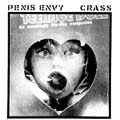
Penis Envy
Crass Records, 1981

Legend has it that the third album by Crass, Penis Envy, climbed to the top of the British independent charts despite not containing any singles. This is not entirely true. Teenage girls flicking through the May, 1981 "Bridal Special" issue of Loving magazine might have noticed a small coupon, nestled between stories like "Dreamy Wedding Dresses and Magical Make-Up" and "How Revealing Is Your Underwear?", advertising a free mail-order flexi disc. "Yes, folks, we've got together with Creative Recording and Sound Services* to offer you the chance to make your wedding day that extra bit special with this romantic song," the offer read. The song, titled 'Our Wedding', was so cheesy as to be absurd. Over pipe organ and church bells, a trembling female voice promised: "All I am I give to you/ You honour me, I'll obey you."

If anyone had looked for other records featuring the singer credited on the disc, Joy De Vivre, they would have stumbled upon on an album sleeve picturing a blow-up sex doll on one side and, on the other, a biblical quote about the creation of woman from man's rib laid over a photograph of pigs hanging in a slaughterhouse. And look for it they did. Especially after NME reported the hoax the following week, on the cover of its own facetious "Bridal Special". At the same time, a pamphlet was making its way around the English music scene – created by the band – which poetically (or melodramatically, depending on your point of view) explained feminist concepts such as the male gaze and accused Loving magazine of selling its readers fantasies of "pure unadulterated shit".

The album behind it all, Penis Envy, must have sounded like an industrial version of hell to listeners who weren't prepared. Far more confronting than the sound of most post-punk bands at the time and only mildly tempered by age, it is an acerbic and thrilling collection of what would probably be known nowadays as "electroclash" – punk vocals mixed with drum machine beats and primitive sound collages, funk bass and electric guitar made to sound like an emergency siren. On 'Health Surface' Joy De Vivre sang in the same satirical feminine voice as on 'Our Wedding', interrupted every now and then by giggles, about hospitals and death. For the rest of the album her counterpart Eve Libertine took over the microphone, spitting lyrics about gender constructions like razor blades: "Poor little filly/ They fuck her mind/ So they can fuck her silly."

* Note the acronym.